

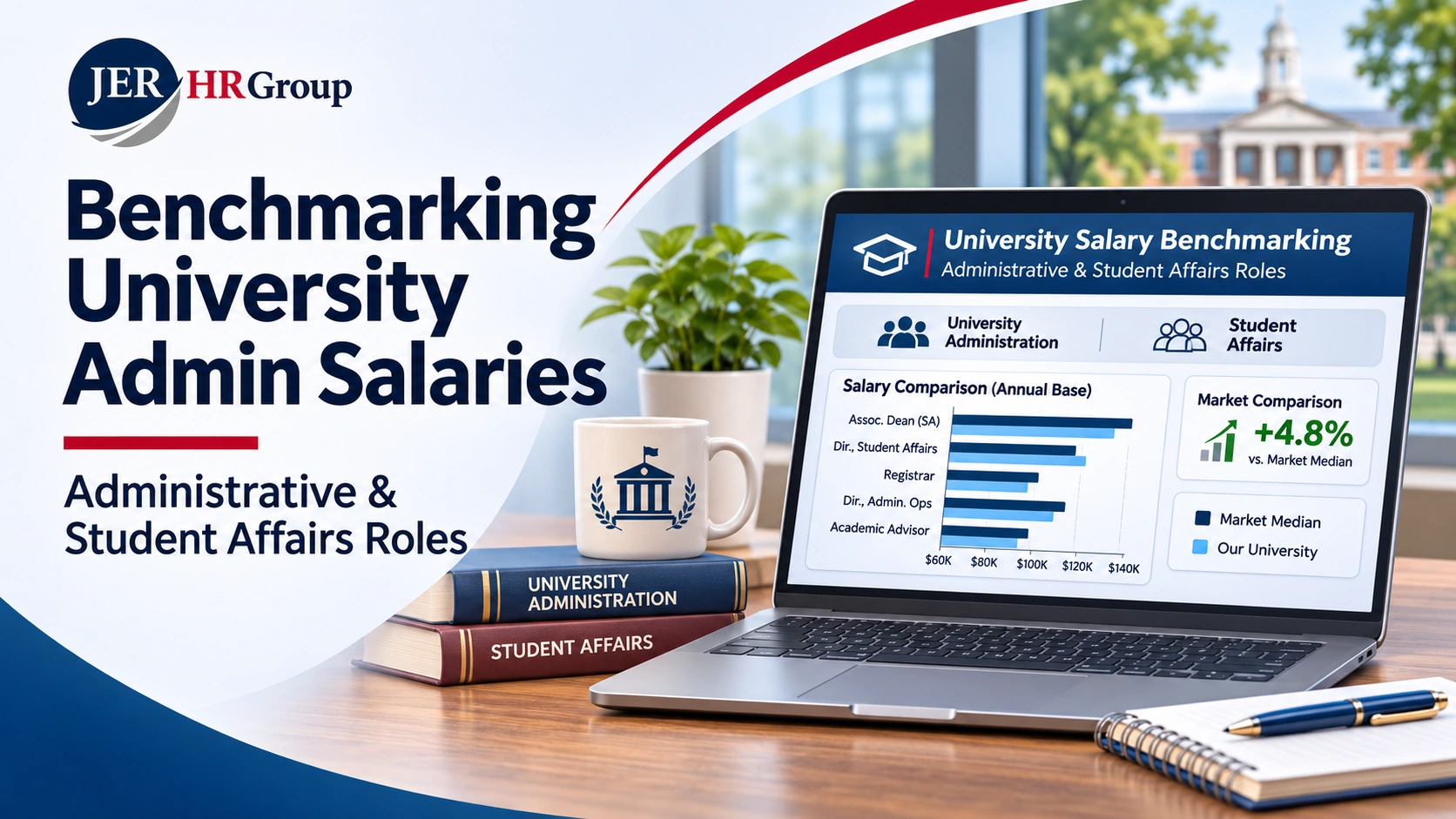
Universities should benchmark administrative and student affairs salaries by matching real job responsibilities to reputable higher education surveys, selecting defensible institution and labor-market peers, and then testing the findings against internal pay structures. One national median cannot answer what an advising director, registrar operations manager or student success specialist should earn.
The decision is whether the comparator reflects the same work, institutional context and recruiting market. This guide addresses US campus HR leaders, provosts and budget committees making administrative and student affairs pay decisions, rather than faculty bargaining or executive pay governance.
By JER HR Group | Updated November 18, 2026 | This is methodological guidance, not an institution-specific salary recommendation or legal opinion. Examples are hypothetical.
Key Takeaways
- Match job content and responsibility before reviewing salary values.
- Use institutional peers and outside talent-market evidence for different purposes.
- Record survey vintage, job code, position definition and data confidence.
- Distinguish market evidence from grade placement and incumbent adjustments.
- Commission independent review when complex jobs or governance demands exceed internal capacity.
Which university positions require different benchmark markets?
Segment institution-wide leaders, program professionals and operational staff. CUPA-HR provides separate Administrators, Professionals and Staff surveys. A position titled director may represent an institution-wide function, a student services program or a small operational team. Job title alone cannot resolve the match.
Begin with approved job descriptions, organization charts, budgets, supervisory spans, specialized duties and the relevant exempt/nonexempt analysis. The job evaluation consulting service and job evaluation versus market pricing guide clarify why classifying internal work differs from establishing external compensation benchmarks. Where jobs are inconsistent across campuses, resolve the architecture first.
How should a university choose peer institutions?
Set a primary comparator group using mission, control, size, academic classification, location and actual competition for employees. A small independent college and a research university may compete for a specialized student accessibility leader while being poor peers for general campus management roles. CUPA-HR DataOnDemand explains custom comparison groups based on institutional characteristics. Use the salary survey data quality checklist to document inclusion, exclusion and low-sample limitations.
| Factor | What to compare | Potential distortion |
|---|---|---|
| Institutional peer | Mission, public/private control, student FTE and operating scale | Prestige selection can disguise different job scopes |
| Recruitment market | Regional versus national market for each role | One geography may not apply campuswide |
| Role content | Reporting level, job duties, credentials and supervisory span | Titles do not establish equivalence |
| Survey reliability | Year, salary definition, participation and sample suppression | A percentile may not be reliable for a thin peer sample |
| Internal policy | Salary ranges, incumbent placement and budget | Market medians are not automatic pay decisions |
Use a separate talent-market check where the university recruits beyond higher education, such as information technology, financial analysis or specialized counseling. A second dataset should be evaluated for comparable responsibilities and salary definitions, not averaged indiscriminately. The compensation survey source evaluation guide can inform source selection.
What evidence should an administrative salary matching file include?
For every position, document its current job ID, actual duties, level, supervisory scope, survey provider, specific survey job code, position description, comparison-group characteristics, salary effective date, available sample details and match confidence. Record reviewer judgments and exceptions so another analyst can reproduce the comparison. A hybrid student affairs role may require transparent custom matching rather than invented precision.
If student services jobs were graded historically without consistent criteria, a classification and compensation study can resolve levels and market placement together. See the classification study versus compensation study comparison before deciding whether external scope should include job architecture, salary analysis or both.
Why should a survey median not determine an employee's salary by itself?
A median summarizes pay in a defined population at a specific time. Verify whether reported compensation means annual base salary or total pay, whether stipends and housing are excluded, and whether the data correspond to the university's workforce. The CUPA-HR 2025–26 professionals methodology describes its collection period and salary measures.
A hypothetical student affairs coordinator who works on campus during evenings may have different conditions from a remote program analyst. Pay administration must explain these distinctions using documented factors. The salary range versus hiring range guide helps separate structure design from offer decisions. Survey percentiles do not create a legal or policy obligation to pay that exact amount.
How should HR convert salary survey data into approved grades?
Compare survey values with current range midpoints, internal career levels, incumbent placement, promotion patterns and annual budget. Decide whether the institution aims to lead, match or selectively lag markets for particular groups. The compensation philosophy consulting service and lead, match or lag examples establish the decision framework.
Model at least three scenarios: priority corrections, phased adjustments and a complete redesign. Disclose salary compression and possible unexplained differences. General market benchmarking does not replace a pay equity audit, and federal or state pay requirements should be considered with qualified counsel.
When is an independent compensation adviser warranted?
Independent support is most valuable for disputed job matches, cross-campus differences, sparse benchmarks, controversial pay decisions or a broad grade redesign. Request a position match log, source register, defensible peer selection, market findings, range options, costed scenarios and an implementation roadmap. JER HR Group provides staff compensation consulting, and its compensation study process guide explains expected stages.
Finance owns affordability; campus HR owns job data and administration; department leaders validate role scope; the appropriate committee approves policy; counsel addresses legal interpretation. The compensation consultant proposal evaluation guide and nonprofit compensation study scope page offer useful procurement questions.
A practical 30–60–90-day implementation path
- Days 1–30: HR validates the in-scope positions, job descriptions, pay data and benchmark decision rights.
- Days 31–60: Analysts perform matching and comparisons, document exceptions and assess internal relationships with finance.
- Days 61–90: Leaders review pay-grade alternatives, cost implementation, obtain required approvals and prepare manager communication.
Recheck matches when responsibilities change and schedule data refreshes. Use the strategic compensation planning framework and 2027 compensation planning checklist to align recurring review with budget cycles. Explore the education compensation consulting page and compensation advisory overview for JER HR Group's related service scope.
Source and interpretation note
Survey methodology should be verified directly with CUPA-HR workforce survey documentation. No salary statistics, client results or consultant credentials have been invented here. The final grade and any legal interpretation remain the institution's responsibility.
Related Education Compensation Buyer Guides
When job levels are disputed before salaries can be benchmarked, use our college job classification RFP guide to define the evaluation scope and deliverables. For K–12 institutions considering a larger external review, see when independent schools should commission a compensation study; school and university market groups are not interchangeable.
Frequently Asked Questions About University Salary Benchmarking
Which CUPA-HR survey should cover a student affairs job?
Use the survey matching actual duties and the survey position definition. Institution-wide administrators, program professionals and operational staff may belong in different segments. Validate the position code before using pay data.
Should university salary peers always be in the same state?
No. Use regional peers for locally recruited roles and broader comparisons when recruiting evidence supports them. Record the peer-selection rationale and major differences in mission, size and role scope.
How can HR benchmark a hybrid student success role?
Identify dominant duties, level and skills, match the closest credible position and document omitted responsibilities. Seek custom analysis where no survey match is reliable; do not invent a blended pay figure.
Is the salary survey median the recommended hiring rate?
No. A median describes a sample at a specific time. Hiring decisions also consider salary grades, experience, internal relationships, recruiting conditions, budget and applicable pay laws.
How often should universities refresh administrative salary benchmarks?
Review market data alongside the annual compensation and budget cycle, with targeted updates when responsibilities or recruiting markets change. Retain survey effective dates and document any adjustment method.
What should an independent university compensation study deliver?
Request validated job matches, peer methodology, data source and sample-quality documentation, market analysis, salary-range options, implementation cost estimates and decision priorities. Define which roles and campuses are in scope.
When should a university review classification as well as pay?
Include classification when inconsistent job levels, titles or outdated descriptions undermine salary comparison. Compensation-only analysis can suffice when the job architecture is already credible and consistently applied.


