

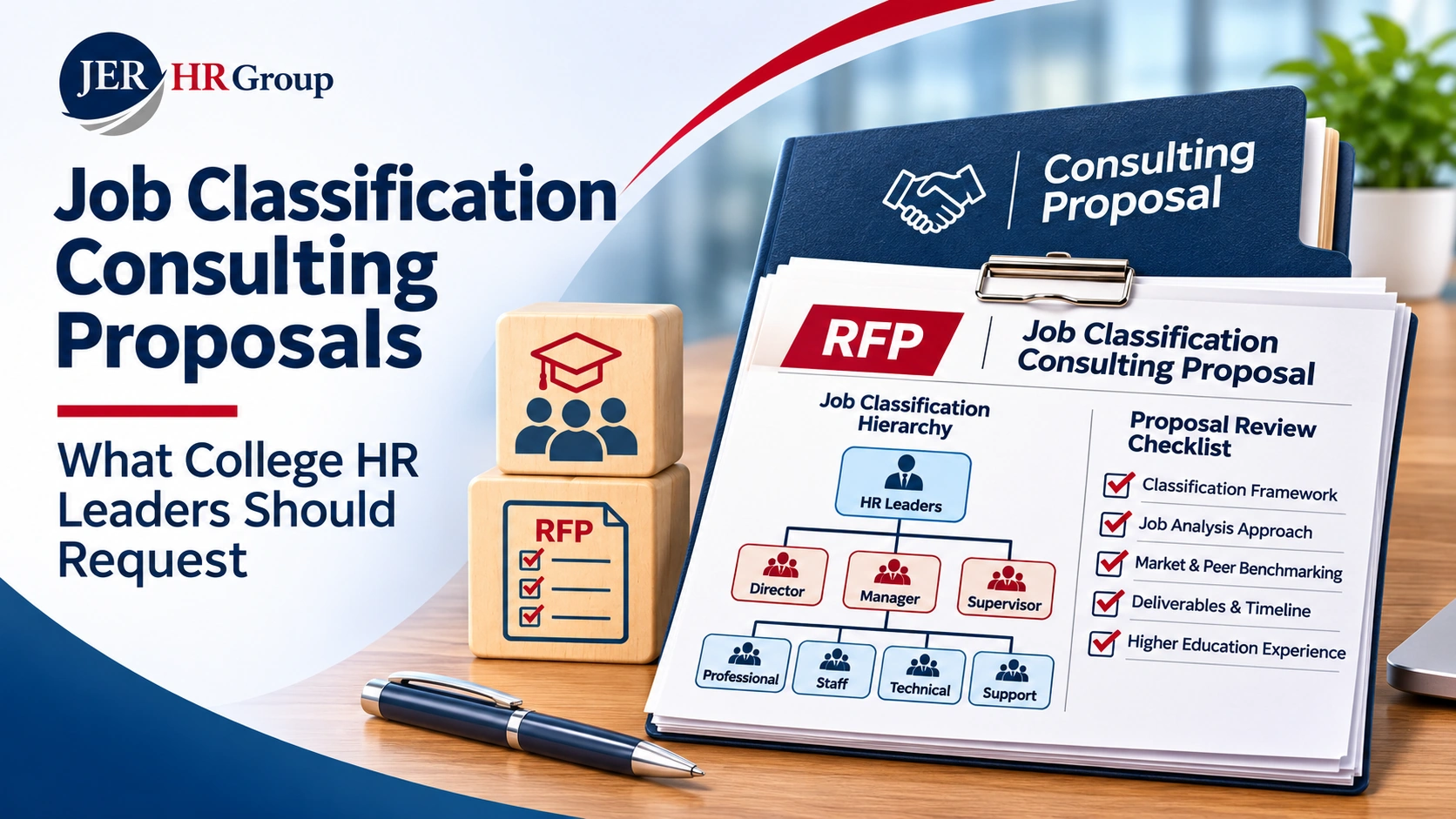
College HR leaders should request a job classification consulting proposal that specifies the job inventory, evaluation methodology, classification standards, stakeholder review process, deliverables, implementation decisions and price assumptions. A credible proposal must show how positions will be reviewed and placed consistently, not merely promise to rewrite job descriptions or deliver a new organization chart.
The procurement goal is a usable job architecture that academic departments, HR, finance and campus leadership can maintain. The right proposal distinguishes internal job evaluation from external salary benchmarking and sets clear boundaries for faculty appointments, represented positions and other special workforce groups.
By JER HR Group | Updated November 18, 2026 | Illustrative RFP criteria, not legal advice or a claim about past client engagements.
Key Takeaways
- Define the job families and employee groups included before requesting a price.
- Require a defensible evaluation method, role-level criteria and exception protocol.
- Ask for sample work products and explicit acceptance criteria, not generic project phases.
- Separate classification recommendations from salary benchmarking and legal exemption determinations.
- Compare consultants on methodology, change management, implementation costing and knowledge transfer.
What should a college job classification study accomplish?
A classification study groups comparable jobs into consistent families and levels based on their responsibilities, skills, scope and institutional impact. The goal is coherent role progression and governance, not a guarantee of equal salaries for every job in a grade. The job evaluation consulting page explains how structured evaluation supports decisions, and the job evaluation versus market pricing guide distinguishes internal job worth from labor-market data.
A college with inconsistent coordinator, specialist, manager and director titles may need institutionwide classification before salary adjustment. Other institutions need only a review of administrative and student-facing positions. The classification versus compensation study decision guide is the relevant boundary, while the classification and compensation studies service describes the broader engagement category.
What input data and job groups belong in the RFP?
Specify the number of positions, occupied and vacant job IDs, campuses, reporting hierarchies, current job descriptions, classification codes, compensation grades and any collective bargaining or faculty scope exclusions. Identify who will validate the actual work when written descriptions are stale. Treat sensitive incumbent data as confidential and set role-based access for the consultant.
A study may cover admissions, registrar, student affairs, finance, development, library operations, IT and facilities. Do not automatically include faculty ranks or positions governed by separate agreements. When market comparisons are required, use job content rather than titles, following CUPA-HR job and comparison-group guidance and the survey quality criteria.
Which deliverables are essential in a classification consulting proposal?
| Deliverable | Required detail | Acceptance check |
|---|---|---|
| Validated job inventory | Positions in scope, job descriptions, reporting structures and exclusions | HR approves a complete inventory and gap list |
| Methodology guide | Evaluation factors, level descriptors, weight logic and review controls | Consistent results across comparable positions |
| Position mapping | Proposed families, grades, role-level changes and confidence notes | Every in-scope job receives a documented outcome |
| Dispute resolution | Appeal path, escalation decision rights and exception register | Stakeholders can challenge matches transparently |
| Implementation model | Costed grade or salary implications where contracted, timeline and communications | Finance and leadership can approve options |
| Handoff materials | Policy recommendations, manager training, maintenance rules and editable files | HR can administer the system after delivery |
Request a small anonymized example of a completed job analysis, rating worksheet or decision memo. This evidence is stronger than a slide describing proprietary expertise. The compensation study process guide helps confirm the proposal's sequencing and the consultant selection framework helps distinguish deliverables from marketing promises.
How should a consultant evaluate jobs without relying on titles?
The proposal should describe a repeatable method for reviewing problem-solving complexity, responsibility, influence, knowledge requirements, leadership scope and organizational impact. The specific factors need not be identical at every institution, but scoring rules must be documented before the consultant evaluates sensitive cases. Distinguish job requirements from individual employee performance.
A college should also ask how the vendor will handle mixed-duty positions, temporary assignments, cross-campus differences and role changes after implementation. The compensation philosophy examples and compensation philosophy consulting service give related context for deciding how internal levels connect to market pay policies.
Does classification determine overtime-exempt status?
No. Classification for organizational and pay-structure purposes is separate from the legal determination of exempt or nonexempt status. The US Department of Labor guidance on the administrative exemption explains why job titles do not determine exemption status and why actual duties matter. Require the proposal to say whether legal wage-hour review is excluded or coordinated with qualified counsel. State-specific obligations can also apply.
A proposed grade mapping should not automatically change exemption status, job terms or employee pay. Review potential pay equity concerns separately with appropriate specialists. The pay equity audit guide explains that a legal compliance analysis has different evidence requirements from an operational classification study.
How should HR evaluate competing consultant proposals?
Use a common scoring rubric instead of choosing the lowest bid without considering work quality. For illustration, a committee might assign 25 points to methodology, 25 to deliverables and quality control, 20 to relevant educational context, 20 to implementation and handoff, and 10 to pricing clarity. Those weights are hypothetical and should be approved by the institution.
Require itemized assumptions for position count, interviews, data preparation, travel, revision rounds, appeals, implementation support and optional market pricing. Compare what counts as a completed deliverable. The compensation study budget and RFP article shows how to avoid unclear estimates; the mission-driven compensation study service is relevant to nonprofit campuses.
How should a classification project move from analysis to adoption?
Start with a data validation and stakeholder interview phase. Pilot the factor definitions on representative administrative, professional and operational jobs. Resolve disputed levels before producing a full classification crosswalk. Then model the effects on grade structures, hiring and promotion policies only if the engagement includes compensation design.
Institutional leaders must authorize the final architecture, appeals route and implementation plan. Connect it with the salary range versus hiring range guide, staff compensation consulting, and strategic compensation planning framework. Training HR staff to maintain new positions and classifications is often as valuable as the initial deliverable.
Procurement checklist for a college HR selection committee
- Agree on the institution's job architecture problem and the positions included.
- Ask each bidder for the same methodology, sample outputs, schedule and exception procedures.
- Compare costs using identical interview, validation, appeal and handoff assumptions.
- Assign HR, finance, department leaders and legal counsel clearly separated review responsibilities.
- Define acceptance tests: validated inventory, defensible role levels, resolved exceptions and usable administrator documentation.
The education compensation consulting page and compensation service overview provide a starting point for scoping. Also review the next-cycle compensation planning checklist for ownership and budget review. This procurement guidance does not claim that any proprietary scoring method is required.
Evidence and limitation note
The CUPA-HR higher education survey framework supports data segmentation; US DOL information supports the distinction between job titles and wage-hour exemption decisions. Legal issues require counsel, and salary recommendations must be supported by licensed or otherwise appropriately sourced market data.
Related Education Compensation Buyer Guides
If the consultant will also price administrative or student affairs jobs, our university salary benchmarking framework explains market matching and survey evidence. For school boards considering whether to begin a review at all, see the independent school compensation study timing guide; a college's governance and job groups will require their own scope.
Frequently Asked Questions About College Job Classification Consulting Proposals
What should be included in a college job classification consulting RFP?
Include the in-scope job inventory, campuses, employee groups, current descriptions, evaluation methodology expectations, stakeholder roles, deliverables, schedule, data protections, acceptance tests and pricing assumptions.
Is job classification the same as salary benchmarking?
No. Classification assesses internal job content and levels, while salary benchmarking evaluates external compensation markets. A project can combine them, but the proposal should show separate methods and outputs.
Should faculty positions be included in the college classification review?
Only when explicitly in scope and appropriate under institutional governance and applicable agreements. Many studies focus on administrative, professional or operational positions. The RFP should identify exclusions and special groups.
What evidence proves a consultant's job evaluation method is consistent?
Ask for documented factors and level definitions, an anonymized rating example, review controls, an appeals process and procedures for handling hybrid roles. Clear application and repeatability matter more than a branded name.
Does a classification consultant decide FLSA exempt status?
Not automatically. An institution's internal job classification is distinct from the legal exempt/nonexempt determination, which requires applicable duties and compensation tests. Define counsel involvement and legal exclusions in the engagement.
How should a college compare classification consultant fees?
Use consistent scope assumptions for position counts, interviews, workshops, revisions, appeals, optional market pricing, implementation assistance and training. Compare total deliverables and quality controls, not just the quoted amount.
What should the final classification study deliver?
Expect an approved job inventory, job-family and level crosswalk, evaluation records, exception decisions, recommendations for affected policies, editable administration documentation and an implementation and training plan.


