

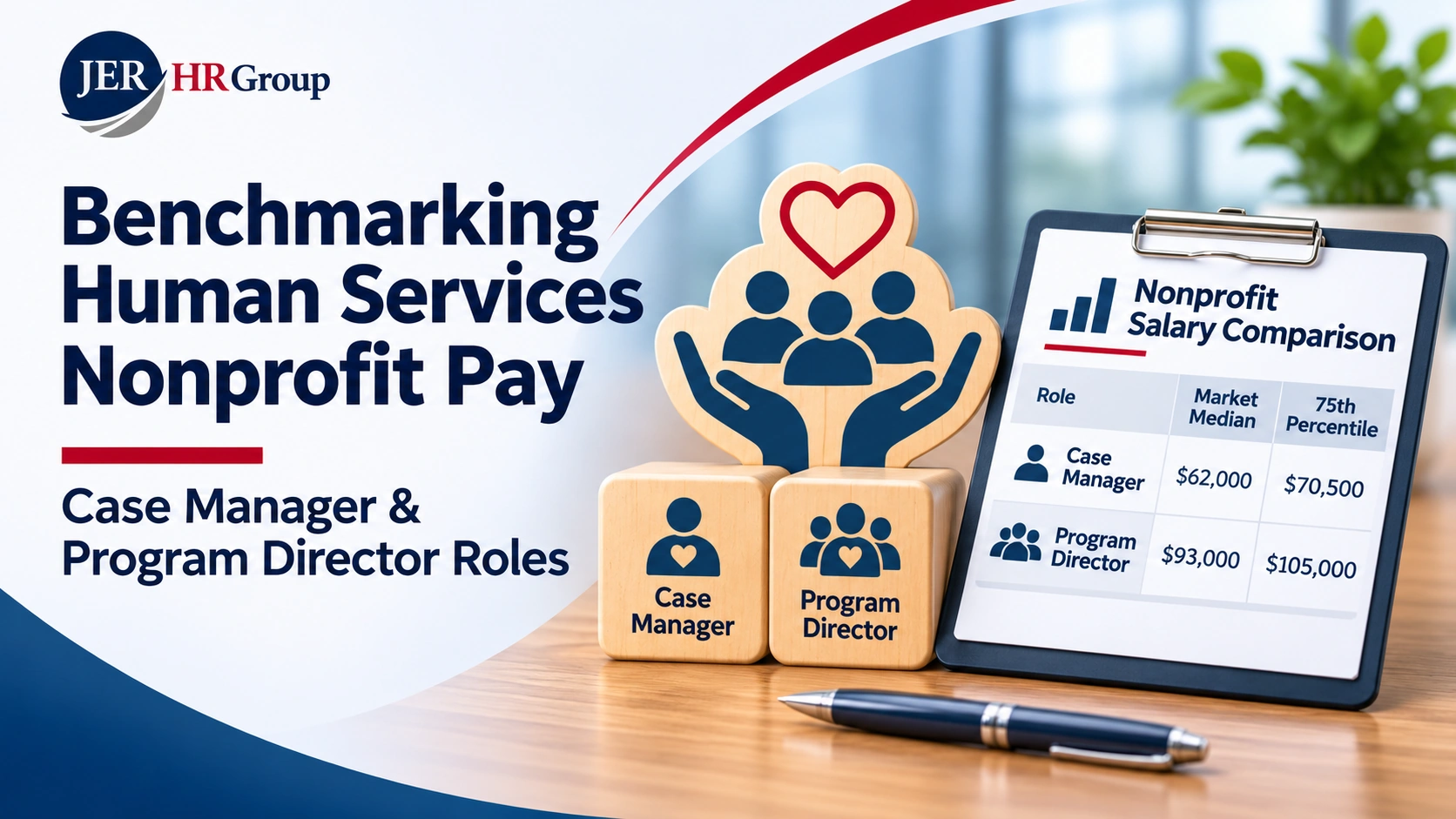
Human services nonprofits should benchmark case manager and program director pay by comparing actual duties, required credentials, program accountability and recruiting markets, not by matching job titles alone. Start with comparable social services organizations, test public-sector or healthcare peers only when they compete for similar work, and document the quality of each data match before recommending salary ranges.
This is an important decision for nonprofit HR directors, COOs, finance teams and boards supporting housing, family services, disability support or outreach. Two employees called "case manager" may have different licensure, caseloads and client risk. A "program director" may oversee one site or several programs and grants. An independent study should make these differences visible rather than bury them inside a single average.
Updated November 18, 2026, for US human services compensation decision-makers. All role scenarios and review rubrics are illustrative, not JER client results or observed customer salary data.
Key Takeaways
- Verify work content and qualifications before selecting external salary data.
- Use human services nonprofit peers first, supplemented by genuine recruiting competitors.
- National BLS wage medians are useful context, not individualized case manager salary quotes.
- Require a match-confidence log that includes rejected and conditional comparisons.
- Build salary ranges, internal-equity checks and fully costed implementation options.
Why Job-Title Matching Fails in Human Services
Case management can cover housing placement, public-benefits navigation, community outreach, family reunification, crisis response or medically supervised treatment. One role may require a social work license and clinical judgment; another may focus on referrals and client documentation. Work location, travel, on-call duty, language access and expected caseload affect staffing demands. Start by validating current job descriptions and distinguishing internal job evaluation from market pricing.
The US Bureau of Labor Statistics reports a May 2025 median annual wage of $45,930 for social and human service assistants. The separate social workers profile reports $61,780 and the social and community service managers profile reports $80,390. Those are national occupation-wide medians spanning different employers, not salary grades or recommended rates for a nonprofit's case manager, social worker and program director.
Which Human Services Positions Need Separate Benchmarks?
| Job family | Match the actual work | Potential labor market |
|---|---|---|
| General case manager | Service population, caseload, documentation and nonclinical qualifications | Similar community service and nonprofit agencies |
| Licensed social worker | Required state license, clinical responsibilities and supervision | Comparable licensed social work settings; relevant healthcare employers |
| Outreach or housing navigator | Field activity, travel, client engagement, shift and safety conditions | Housing and community outreach organizations |
| Case-management supervisor | Number of reports, quality assurance, coaching and escalations | Human services program supervisors |
| Program director | Budget, grant portfolio, program outcomes, staffing and decision rights | Program leaders at comparably complex nonprofits |
These are match questions, not assertions that a particular survey includes or omits a specific title. The ASU Lodestar 2026 Nonprofit Compensation and Benefits Report covers more than 50 job titles and allows comparisons by organization type, including human services, and budget size. Confirm the licensed definitions, respondent sample and geographic scope before relying on any figure. Consult the nonprofit compensation data-source comparison for alternative sources.
How Should a Nonprofit Select Peer Employers?
Create three comparison rings. First, select social services nonprofits with comparable client populations, program models and scale. Second, include realistic competitors for the talent, such as county departments or healthcare employers, but only where job requirements really match. Third, use broader published occupational data for context and reasonableness checks. The peer geography for local outreach roles may differ substantially from the geography for senior leadership recruited statewide.
Check publication year, number of valid observations, base-pay versus total-cash definitions, organizational type and role scope. Do not average unrelated pay points to manufacture a precise midpoint. The salary survey quality checklist helps identify weak data, and custom salary surveys are appropriate when a consequential role has no defensible published match.
What Belongs in a Job-Match Confidence Log?
| Factor | Acceptable evidence | Potential mismatch |
|---|---|---|
| Job duties | Similar client services and scope | Identical title but materially different function |
| Credentials | Equivalent required qualification and licensure | Clinical and nonclinical positions mixed |
| Managerial level | Comparable staff, budget and decision authority | Director title without equivalent responsibility |
| Talent market | Realistic competing employer and location | National rate used for a locally recruited role |
| Pay definition | Clear year, sample and compensation elements | No sample or pay-component disclosure |
Label every comparison strong, conditional or unsuitable, with a sentence explaining why. A conditional match may be useful as supporting context; it should not silently become a primary benchmark. This is a proposed review rubric, not a validated mathematical instrument. The compensation study process shows how job data, market analysis and range design connect.
How Can Benchmarks Become Useful Salary Ranges?
External market values should inform, not dictate, the internal grade structure. First validate representative pay comparisons; next evaluate job responsibilities and the organization’s compensation philosophy; then model ranges for job families and levels. The nonprofit pay benchmarking and salary-range guide explains the sequence. Salary administration makes the resulting rules operational for future offers and reviews.
Consider a hypothetical nonprofit with a nonclinical navigator, a licensed social worker and a supervisor of both teams. The appropriate grades should reflect work, skill and accountability rather than a blanket rule that anyone with a particular license must outrank every supervisor. Different market rates may justify documented exceptions or separate tracks when evidence supports them. The salary versus hiring range guide helps preserve progression room for existing staff.
How Should You Test Internal Equity and Salary Compression?
Compare newly proposed hire rates with current employees doing substantially similar work, accounting for legitimate job-related differences. Review the relationship between frontline staff and their supervisors and assess whether repeated market exceptions have weakened the structure. Where disparities warrant deeper assessment, the pay equity audit scope guide defines a different and more specialized engagement.
Translate each range option into first-year and recurring cost, including taxes, benefits, shift coverage, overtime interactions and restricted grant budgets where relevant. The 2027 nonprofit compensation planning checklist supports budgeting, while the nonprofit compensation policy guide helps clarify who approves offers, range changes and exceptions.
What Should the Consultant Deliver?
- A validated inventory of jobs, qualifications, service locations and excluded positions.
- A peer selection rationale, data-source log and match-confidence assessment for each benchmark job.
- Market-position findings, grade and salary-range options and internal compression observations.
- Costed implementation scenarios showing timing, benefits burden and prioritization.
- A decision-ready presentation for HR, finance and the board, with limitations made explicit.
- Editable documentation so staff can maintain the methodology after the engagement.
If only a few jobs lack reliable comparisons, a targeted assessment may be better than a full agency-wide review. The nonprofit compensation studies service and nonprofit compensation RFP budgeting guide can help scope a sensible engagement. Ask a prospective nonprofit compensation consultant to show how they reject an invalid salary match.
When Should a Human Services Nonprofit Commission External Research?
Commission targeted research when a meaningful hiring, promotion, board or budget decision depends on an uncertain market match. If job descriptions and comparators are already current, an annual refresh may be enough. Consider the broader nonprofit compensation practice or staff compensation consulting when the problem spans several job families.
Start with the five or ten positions for which a different benchmark would materially change a salary decision. Bring current descriptions, service settings, hiring history and financial constraints to the scoping conversation. The objective is not merely to buy data; it is to make a documented, defensible pay decision that leadership can explain.
Human Services Salary Benchmarking FAQs
What is the best survey for human services case manager salaries?
Choose a current nonprofit survey whose job definition matches your case manager duties, region and employer type. Supplement carefully with local public or healthcare employers when responsibilities and qualifications align.
Can BLS social worker pay be used as a case manager benchmark?
Not directly. Social workers and case managers may differ in licensing, responsibilities and service setting. BLS figures provide context, not an automatic salary recommendation.
How do you benchmark a program director overseeing several programs?
Match responsibility for program mix, grant budgets, staffing, credentials, decision authority and service outcomes. Document whether any survey director job is an exact or conditional match.
Should licensed and nonlicensed case managers use different salary grades?
Possibly. First evaluate actual duties, job levels, required credentials, recruiting markets and incumbent relationships. Licensing is relevant when it changes job requirements, but does not automatically determine the grade.
What deliverables should HR require from a compensation study?
A validated job inventory, survey peer and match log, market reference values, proposed grades and ranges, internal-equity findings, costed options and an editable administration guide.


