

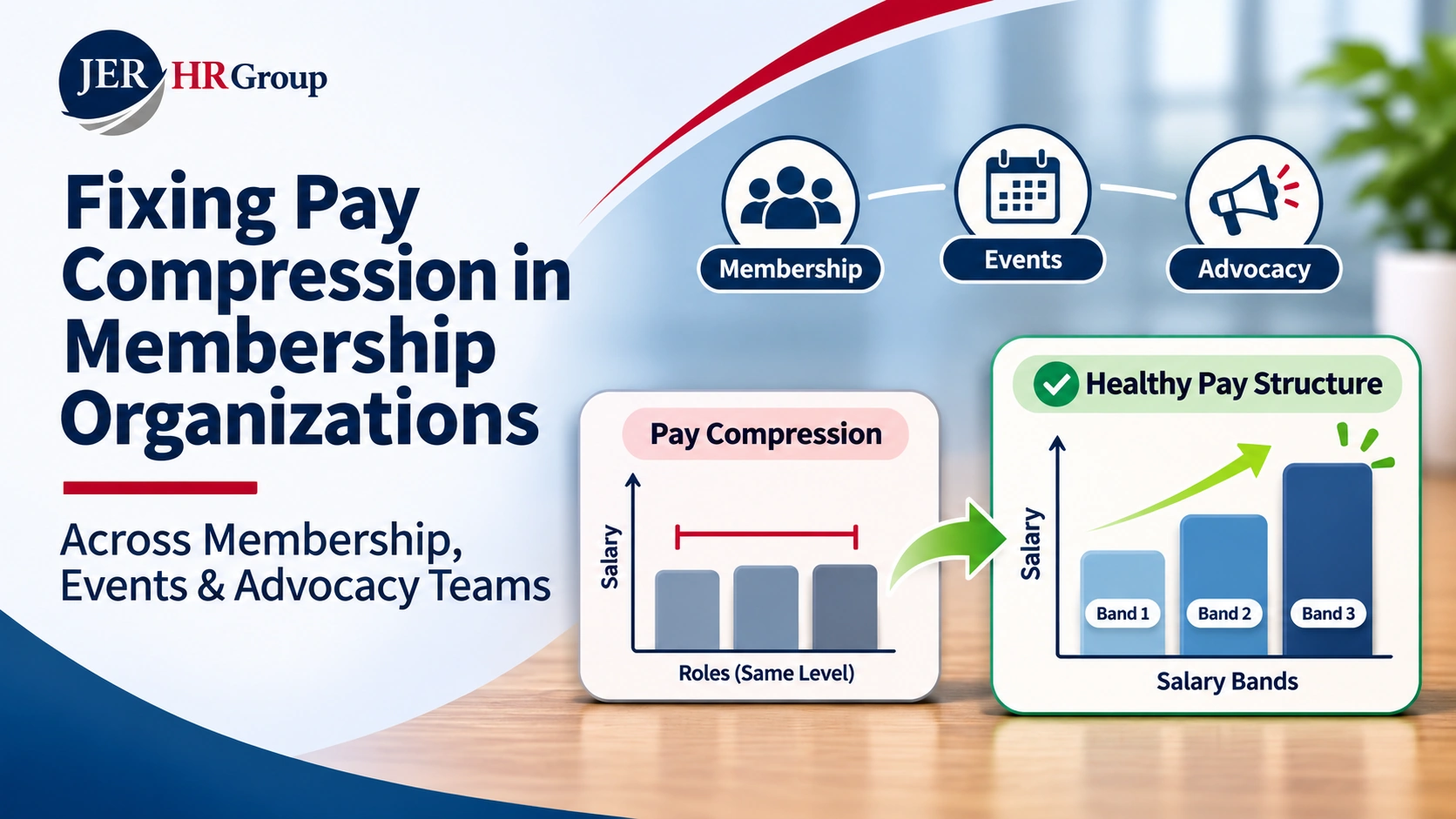
Membership organizations can fix pay compression by identifying where pay differences no longer reflect job level, responsibilities, experience or legitimate market factors, then correcting ranges and individual pay decisions in a documented order. Membership, events and advocacy teams need role-specific market data, comparable job levels, an internal equity review and a funded adjustment plan rather than indiscriminate across-the-board increases.
Compression becomes especially difficult when a new membership growth hire enters above an experienced director, a conference sales specialist earns close to an events manager, or a government affairs specialist is recruited from a more expensive market. Those situations are signals to investigate, not automatic evidence of unlawful discrimination or proof that every employee should receive the same raise.
For US trade and professional association HR leaders, CEOs and finance directors. Updated November 18, 2026. Examples are hypothetical, not JER HR Group client findings; employment-law issues require appropriate counsel.
Key Takeaways
- Separate three problems: new-hire compression, pay inversions between job levels and uneven market positioning across functions.
- Compare properly leveled roles: membership, event sales and advocacy positions may compete in different external labor markets.
- Diagnose before increasing pay: review job descriptions, salaries, grade placement, tenure, skills and relevant compensation variables.
- Model phased corrections: address unjustified gaps, redesign ranges and manage the cost of future hires or promotions.
- Protect pay equity: investigate unexplained differences and applicable federal/state requirements; do not reduce wages to cure an illegal gap.
What Does Pay Compression Mean in a Membership Organization?
Pay compression occurs when compensation differences are too small to reflect distinctions that the organization's pay system is designed to recognize. For example, a long-tenured employee might earn barely more than a newly hired colleague with the same core job, or a supervisor might earn close to the pay of a specialist with substantially narrower responsibility. The University of Colorado compensation glossary describes both new-hire and structural compression.
Not all narrow pay gaps are problematic. Two employees doing substantially similar work with similar skills and performance may appropriately earn similar salaries despite tenure differences. The relevant question is whether the difference, or lack of difference, is consistent with a credible, documented compensation philosophy. The compensation philosophy guide provides a starting point for defining what the organization intends to reward.
In associations, team structure adds complexity. Membership employees may manage recurring revenue and relationship portfolios. Events roles may combine logistics with sponsorship sales, while advocacy staff may require scarce policy expertise. Comparing only titles or base salaries can hide differences in incentive design and labor-market demand. The association job-matching guide explains where custom survey analysis is warranted.
Identify the Type of Pay Compression Before Choosing a Remedy
| Symptom | Association example (illustrative) | Diagnostic question | Potential response |
|---|---|---|---|
| New-hire compression | A newly recruited membership manager earns almost as much as an experienced manager | Are their job scope, skills, performance and external market comparable? | Review incumbent positioning and hiring range controls |
| Supervisor or grade inversion | An events revenue specialist earns more than a manager supervising another function | Is the specialist's market genuinely higher, or are grades and scope misclassified? | Validate job levels, differentiate market premiums and fix unsupported inversion |
| Cross-function compression | Membership, events and advocacy directors have similar titles but inconsistent positioning | Are market sources and grades being applied consistently to genuinely comparable work? | Rebuild job architecture and document function-specific market sources |
| Promotion compression | A promoted advocacy employee receives little movement relative to added duties | Was the promotion priced within the correct range, and were peers reviewed? | Set transparent promotion rules and adjust justified outliers |
| Range compression | Hiring offers cluster near a stale range maximum while incumbents remain in the middle | Are min/mid/max values and hiring ranges aligned to current market data? | Refresh ranges and budget incumbent adjustments |
| Incentive-pay distortion | Events sales variable compensation makes total pay comparisons appear inverted | Are base and variable components being compared on equivalent terms? | Separate fixed and variable pay and evaluate total cash carefully |
Use this table to frame a diagnostic, not to impose automatic salary rules. The public-sector pay compression article covers a different employer context and should not replace association-specific labor markets. The salary versus hiring range guide helps identify whether an organization's offer policy is creating the problem.
Step 1: Build a Reliable Pay and Job Dataset
Start with a secure inventory of position descriptions, job levels, locations, base salary, variable pay, employee tenure, relevant experience, time in role, promotion date, performance and job-market references. Collect demographic data where lawfully appropriate to support a privileged or counsel-reviewed pay-equity assessment. Make access controls and confidentiality explicit.
Mark any roles that have significantly changed or combined membership, events and advocacy duties. A mislabeled role can create the appearance of compression even if the underlying jobs are not comparable. Use job description best practices and job evaluation versus market pricing to validate work scope before comparing pay.
Calculate the employee's position within the approved salary range and compare similarly leveled roles. Avoid turning an arbitrary 'acceptable compression percentage' into a policy without evidence. An illustrative relationship is new-hire salary divided by the comparable incumbent's salary; interpret the value together with role match and legitimate pay factors, not as a compliance finding.
Step 2: Validate Separate External Markets for Membership, Events and Advocacy
Use association-specific sources first. ASAE's 2026–2027 Compensation & Benefits Study reports 69 association positions from more than 400 participating organizations and can inform appropriately matched association jobs. However, it is not proof that every specialized event sponsorship, membership commercialization or legislative advocacy post matches a published position exactly.
For roles with weak matches, consider the custom survey versus published data decision framework. Check survey dates, pay definitions, sample sufficiency and organization filters with the market data quality criteria. Compare externally competitive roles with justified labor-market sources instead of using a single indiscriminate percentage increase across all three departments.
Separately document whether sales commissions, event bonuses or other incentives explain observed total cash relationships. The nonprofit incentive compensation guide can help frame a compensation design review; it should not be used to assume all association jobs warrant variable pay.
Step 3: Test Internal Equity and Identify Unexplained Pay Differences
Pay compression and pay discrimination are different questions. A narrow pay gap may be justified or may signal a structural issue; a protected-class wage disparity may create legal risk even without classic compression. Review comparable work and documented pay factors, and ask counsel to evaluate applicable federal and state requirements. The EEOC's compensation discrimination guidance describes the scope of federal pay protections, including salary and benefits.
Do not assume a market premium explains every disparity. Check whether the organization has consistently applied its recruiting, promotion, merit and incentive policies. Where appropriate, perform a separate pay equity analysis and review the pay equity audit service scope before finalizing salary changes. The remedy should address the underlying cause, not just make a spreadsheet look uniform.
Under the federal Equal Pay Act, an employer cannot resolve a prohibited differential by reducing another employee's wages. See EEOC Equal Pay Act guidance. State laws may impose additional duties concerning pay transparency, recordkeeping or permitted salary history; confirm which rules apply to the organization's locations.
Step 4: Model Costed Corrections Before Changing Pay
Create scenarios with the finance leader: (a) immediate correction of verified inequities or serious inversions, (b) prioritized market adjustments for critical roles, and (c) structural range changes staged over a budget cycle. Do not imply that a phased plan may defer legally required remedies. Each scenario should identify affected roles, payroll cost, recurring effects, new-hire implications, estimated timing and required approval.
Range redesign should explicitly define minimum, midpoint and maximum, grade criteria, hiring ranges and promotion parameters. If a specialist market differs materially from other roles at the same level, document any premium rather than concealing it in job titles. The strategic compensation planning framework and 2027 nonprofit compensation planning checklist help translate corrections into a budget process.
A worked example might be an events director whose range is materially behind the current market while a newer sponsorship specialist was hired above the old maximum. The solution may involve confirming role classification, adjusting a position's range, reviewing the incumbent's pay and changing offer controls. This is a hypothetical planning example, not a claimed customer result.
Step 5: Repair the Policies That Recreate Compression
Even successful adjustments can unravel if offers, promotions and merit decisions continue without controls. Adopt written hiring approvals for offers near or above the range midpoint, require comparison with similarly situated incumbents, document exceptions, set review cadence for changing market roles and train managers to explain how grade, performance and scope affect pay.
Communications matter. Employees do not need confidential peer salaries to understand how their own pay is structured, how ranges are maintained and what happens after expanded responsibilities. Use the compensation communication guide and nonprofit compensation policy checklist for the broader communication and governance framework.
What Should an Association Compensation Consultant Deliver?
Request a diagnosis separating new-hire compression, pay inversions and cross-function market problems; validated job architecture and role matches; a current market source inventory; an internal equity findings summary; proposed ranges and costed adjustment scenarios; a prioritized action plan; and manager-ready rules for future hires and promotions. A study without implementation choices may not solve the issue.
Decide whether the engagement requires counsel-led pay-equity review, comprehensive classification, or only a targeted diagnostic. The compensation study RFP scope guide can help procure comparable proposals. The consultant evaluation checklist and compensation study process help define evaluation criteria and deliverables.
Checklist for Membership, Events and Advocacy Leaders
- Document the exact compression symptom and the affected jobs.
- Validate responsibilities, grade levels, workforce data and pay components.
- Compare like roles internally, noting legitimate pay factors and unexplained deviations.
- Audit association-specific and supplemental market benchmarks by job family.
- Assess pay-equity risks and applicable legal obligations with qualified counsel.
- Cost immediate and staged corrective scenarios, with clear owners and deadlines.
- Update offer, merit, promotion and exception rules to reduce recurrence.
Keep the CEO pay question separate. The trade association CEO benchmarking guide covers independent board reviews, while the custom benchmarking for hybrid association roles addresses job-matching problems. For general context see nonprofit compensation strategy decisions and the survey-data source overview.
Related Membership Organization Compensation Resources
Explore association compensation consulting, nonprofit salary range planning, external compensation consulting benefits, and compensation governance guidance before launching a broader restructuring project.
Editorial note: This article presents a hypothetical association diagnostic framework. The ASAE study's public scope, EEOC guidance and compensation glossary are referenced without reproducing proprietary data or making a legal finding about any employer. Obtain legal advice for pay-equity and jurisdiction-specific requirements.
Frequently Asked Questions About Association Pay Compression
What is pay compression in a membership organization?
Pay compression occurs when differences in compensation are small relative to distinctions the pay structure is intended to recognize, such as job level, scope or relevant experience. Common signals include a new hire earning nearly as much as a comparable long-tenured colleague or an inversion between managerial and individual contributor positions. Not every narrow pay gap is unfair or unlawful.
How can associations identify pay compression across membership, events and advocacy?
Build a secure pay and job dataset, validate role levels, compare similarly situated employees, measure position within salary ranges and evaluate new hire, promotion and total cash relationships. Segment membership, events and advocacy by their real talent markets and pay components. Investigate material differences rather than relying on a single arbitrary compression ratio.
Should every employee get the same raise to correct pay compression?
Usually not. Equal percentage increases can preserve the underlying gap and may spend budget without fixing misclassified roles or outdated hiring policies. Determine the root causes, address legal inequities promptly, correct unsupported inversions and cost targeted range or incumbent adjustments. Apply consistent criteria and communicate the program transparently.
Can an events specialist appropriately earn more than a membership manager?
Possibly. Different job markets, scarce specialist skills, incentives and responsibilities can justify some pay differences. First compare the full role scope and the definition of total compensation, including any events or sponsorship incentives. An apparent inversion should be documented and assessed, not automatically treated as a compensation policy violation.
How does pay compression differ from unlawful pay discrimination?
Compression describes a salary-structure or relative-pay pattern. Pay discrimination concerns legally prohibited differences related to protected characteristics or other unlawful practices. They may coexist but are not equivalent. Review comparators and documented legitimate factors, and consult qualified counsel about federal and state pay laws before choosing remedies.
Can a pay-equity problem be fixed by reducing another employee's wages?
Under the federal Equal Pay Act, employers cannot correct an unlawful sex-based wage differential by lowering another employee's wages. Use appropriate legal guidance to address any prohibited compensation practices and model the financial effects of compliant corrections. A general pay-compression project should not be mistaken for a complete legal pay-equity audit.
What deliverables should an association pay compression consultant provide?
Request a root-cause diagnosis, validated job levels, salary-range and market-data review, internal equity findings, prioritized cases, costed correction scenarios and a plan to prevent recurrence. Implementation guidance should cover hiring offers, promotions, pay exceptions, communication and review cadence. The final report should distinguish immediate legal issues from broader compensation design choices.


