


A pay equity analysis compares compensation among similarly situated employees, evaluates whether differences are explained by documented job-related factors, and identifies disparities that may require further review or remediation.
When the Equal Pay Act was enacted in 1963, women were paid 59 cents on the dollar compared with male counterparts, a 41% wage gap. Although the gap has narrowed, it still exists.
How Large Is the Pay Gap?
The article’s cited 2022–2023 sources reported that women earned about 82 cents for every dollar earned by men for work of similar value.1 The pay gap is even wider for women of color, mothers of young children, and women with disabilities.
In 2022, men were paid $10,381 more than women across the nation.2 Over the course of a 40-year career, women stand to lose approximately $407,760.3 Imagine the impact of that earned income if available to invest in her 401k, for her children’s education, or to purchase a family home. The opportunity for economic growth and financial security is significantly diminished when women and minorities aren’t paid the full rate for which they have worked.
Why Pay Equity Matters for Retention and Risk
Pay equity affects employer brand, recruiting, retention, employee trust, and compliance risk. Employees increasingly expect transparent and consistently applied pay practices.
Organizations should review pay decisions throughout the employee lifecycle—including hiring, promotions, adjustments, bonuses, and incentives—and document the job-related factors used to explain differences.
How to Conduct a Pay Equity Analysis: 7 Steps
- Protect your organization – partner with legal counsel to establish legal privilege.
- Run an employee census report from your HRIS/payroll system. Group employees based on salary grade (if you have a salary structure) or based on substantially similar work or work of equal value.
- For each employee group, calculate average pay for 1) male versus female and 2) white versus non-white incumbents. This results in your Raw Pay Gap.
- Add columns for tenure, years and level of experience, specialized skills/education, job performance, and other factors that are potentially acceptable reasons for differences in pay.
- Within each employee group, highlight incumbents who earn less than the average for male and white incumbents. Provide rationale for any pay differences that appear to be acceptable reasons.
- If pay anomalies are not based on permissible factors, consider what remediation is necessary. Do not treat a fixed percentage difference as automatically acceptable. If an apparent disparity remains after considering documented, job-related factors, work with counsel and qualified compensation professionals to evaluate statistical significance and appropriate remediation.
- Develop and communicate your compensation strategy statement to employees. Convey your commitment to reviewing pay equity on an annual basis and assessing all pay decisions as they occur, including promotions, adjustments, new hire offers, etc. This includes decisions about base salaries, bonuses, and any other incentives.
How to Prepare Data for a Pay Equity Analysis
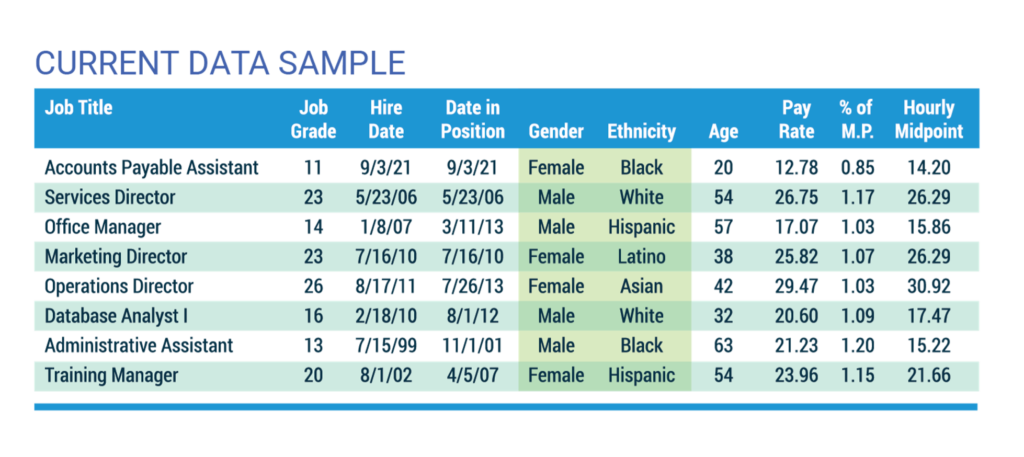
Data with Recommended Adjustments

Look Beyond the Numbers
Consider whether there is potential for bias (implicit or explicit) in the measures used to determine successful job performance, and whether all incumbents have equal opportunity to meet the performance metrics. For example, if your organization rewards employees for on-call availability, this may exclude some of your employees from meeting that performance metric, so you would want to ensure that there are other ways for employees to demonstrate successful performance. This is where it becomes important to understand root causes so that systemic pay gaps can be addressed, rather than addressing only the symptoms.
Pay Equity Technology Solutions
Since the manual process can be cumbersome, it is worth mentioning a few technology solutions that can help to ease the burden.
Decusoft offers a comprehensive compensation management software called The Compose® Suite. The software provides analytics and dashboard reporting capabilities of employee demographic and compensation data, including current compensation, salary progression, gender, race, ethnicity, age, tenure, disability status, veteran status, salary grade, and location. You can look at compensation by performance rating, ethnicity, age, gender, or a combination of data categories, thus there is ample opportunity to filter by intersectionality.
JER HR Group offers CompBldr, a compensation analysis SaaS (software as a service) solution. This technology allows you to analyze pay by gender, race/ethnicity, age groups and other relevant data in comparison to internal mean pay lines. Pay differences by similar job valued positions and glass ceiling pay disparities are also identified, all presented in easy-to-understand visual reports. Consultants are available for further analysis to evaluate if justified or unjustified systemic pay disparities exist and need to be mitigated or eliminated.
Build an Ongoing Pay Equity Process
A pay equity compensation analysis helps corporate executives and HR leaders obtain a clear picture of the current state of pay equity within the organization, and identifies where significant pay inequities exist. With this knowledge, you can build a path forward that mitigates risk today, improves your employer brand, and positions your organization for success for years to come. Contact JER HR Group to discuss our compensation and pay equity analysis services in the for-profit, nonprofit, and government/public employee sectors. info@jerhrgroup.com 866.475.7687.
Authored by Renee Martin, SHRM-SCP, Senior Compensation Consultant, JER HR Group. The original article appears in HR Professionals Magazine March 2023 issue.
Sources
- Payscale, “2022 State of the Gender Pay Gap Report.”
- Org, Wheelwright, Trevor. “The Gender Pay Gap Across the U.S. in 2022.” March 1, 2022.
- U.S. Equal Employment Opportunity Commission, “A Message from EEOC Chair Charlotte A. Burrows on Equal Pay Day.” March 15, 2022.
- Syndio. “The New Way to Fair Pay.” January 2023.

Renee L. Martin, SHRM-SCP
Senior Consultant
JER HR Group
Email
Renee L. Martin, SHRM-SCP, is a Senior Consultant with JER HR Group, a human resource firm helping clients resolve their toughest challenges in compensation, employee learning, organizational development and HR. JER HR Group works collaboratively with clients to solve big challenges, meeting clients wherever they are on the path to understand culture, issues, and change. You can reach author Renee Martin at rmartin@jerhrgroup.com 717.673.9116. @jerhrgroup


