
Training Bottlenecks: Trainer, Culture and Technology Capacity
Training bottlenecks are constraints that prevent people from accessing, completing, applying, or improving workplace learning. Technology bandwidth matters, but so do trainer capacity, employee time, manager support, content maintenance, accessibility, and decision rights.
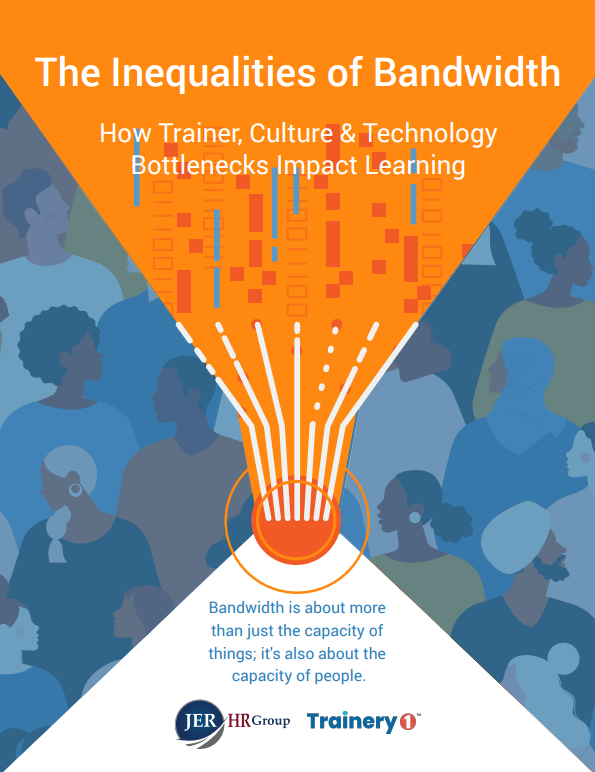
This page previews The Inequalities of Bandwidth: How Trainer, Culture & Technology Bottlenecks Impact Learning. The white paper broadens “bandwidth” beyond network speed to examine the human and organizational infrastructure required for learning. Use the planning framework below to identify which constraint is limiting the system before investing in more content or technology.
Training Bottlenecks: Signals and Responses
| Constraint | Possible signal | Questions to investigate |
|---|---|---|
| Trainer capacity | Long development queues, inconsistent facilitation, or no time to update materials. | Which work requires expert design or facilitation? What can be standardized, delegated, or retired? |
| Learner time and workload | Low participation, rushed completion, or weak application during peak periods. | Is paid learning time protected? Are priorities and staffing compatible with participation? |
| Manager support | Employees attend but have no opportunity, feedback, or authority to use the learning. | What must managers reinforce, observe, and remove from the workflow? |
| Culture and psychological safety | People avoid practice, questions, or feedback because mistakes carry social or career risk. | Can learners ask for clarification and practice without humiliation or retaliation? |
| Technology and access | Login failures, device limitations, inaccessible media, unstable connections, or fragmented records. | Does the platform fit the workforce’s devices, locations, accessibility needs, and support model? |
| Content and governance | Duplicated, outdated, ownerless, or contradictory training. | Who approves, versions, reviews, and retires content? |
| Measurement capacity | Dashboards report activity but do not guide a decision. | Which evidence would change program design, support, or resource allocation? |
Start With the Required Work
List the roles, tasks, risks, and changes that create a learning need. Separate mandatory or high-consequence learning from development opportunities and optional enrichment. Then estimate audience size, frequency, subject-matter complexity, practice requirements, accessibility needs, and maintenance burden. This demand picture keeps a visible, popular topic from displacing a smaller but more consequential need.
Assess Trainer and Subject-Matter Capacity
Trainer capacity includes design time, facilitation skill, subject-matter access, quality review, administration, technology support, and content maintenance. Do not schedule every available hour for delivery; leave capacity for preparation, learner support, evaluation, and updates. When experts contribute, define the decisions they own and translate their knowledge into usable objectives, examples, and feedback criteria.
Protect Learner Time and Opportunity
Training cannot be absorbed reliably when employees are expected to learn while simultaneously meeting an unchanged workload. Define paid participation time, coverage, deadlines, device access, and manager expectations. After learning, participants need a real opportunity to practice or apply the behavior. If opportunity is scarce, reduce cohort size, change sequencing, or provide simulation and coaching.
Treat Manager Support as Infrastructure
Managers shape scheduling, relevance, reinforcement, and psychological safety. Give them a short implementation brief covering why the learning matters, who participates, what behavior should change, what support employees need, and where questions should go. Avoid vague instructions to “hold people accountable” without defining the behavior, evidence, authority, and fair response process.
Evaluate Technology as Part of the System
A learning platform should fit the actual workforce and operating environment. Review authentication, mobile use, low-bandwidth access, captions and transcripts, keyboard and screen-reader support, language needs, privacy, security, integrations, reporting, support coverage, and content portability. A feature-rich platform can still become a bottleneck when administration is complex or learners cannot use it consistently.
Build Content Governance
Assign an owner, approval path, version, review date, source record, and retirement trigger to important learning assets. Prioritize updates when law, policy, systems, products, hazards, or job responsibilities change. Keep a controlled catalog so employees and managers can distinguish required learning, recommended development, and outdated material.
Use a Capacity Planning Sequence
- Define demand: identify audiences, objectives, timing, risk, and required evidence.
- Map constraints: document trainer, learner, manager, technology, content, and governance limits.
- Set priorities: use consequence, urgency, reach, dependencies, and readiness—not visibility alone.
- Choose the smallest viable intervention: decide whether the need calls for training, a job aid, coaching, process redesign, system support, or a combination.
- Reserve support capacity: plan for accessibility, administration, questions, facilitation, remediation, and maintenance.
- Pilot under realistic conditions: include representative roles, devices, locations, schedules, and access needs.
- Review evidence and rebalance: remove unused content, correct barriers, and shift capacity toward demonstrated needs.
Measure the Bottleneck, Not Just the Output
| Measure | What it may reveal | Caution |
|---|---|---|
| Wait time from request to launch | Design, review, or approval capacity constraints. | Fast launch does not prove quality or relevance. |
| Access and support incidents | Authentication, device, accessibility, or help-desk friction. | Low reporting may reflect an unclear support route. |
| Participation by role, location, or shift | Scheduling, coverage, communication, or access differences. | Use small-group data carefully and protect privacy. |
| Practice and application evidence | Whether learners can use the intended behavior. | Opportunity and manager support affect results. |
| Content age and review status | Maintenance debt and governance gaps. | Age alone does not determine accuracy. |
JER HR Group’s learning analytics guide explains how to connect evidence with program decisions.
Common Training Capacity Mistakes
- Buying more content when the constraint is time, support, or application.
- Equating network bandwidth with the entire learning infrastructure.
- Planning instructor hours without design, preparation, support, or maintenance time.
- Scheduling learning without adjusting workload or coverage.
- Assuming one device, language, location, or delivery method fits every learner.
- Using completion volume as the primary capacity or effectiveness measure.
- Adding tools without assigning governance, integration, privacy, and support ownership.
Use the White Paper to Find the Limiting Constraint
Download the original white paper below and review trainer, learner, culture, and technology bandwidth together. Identify the constraint that most limits access or application, assign an owner, and test a focused correction before expanding the learning portfolio. For related system guidance, review JER HR Group’s continuous learning framework and training delivery guide.
To discuss learning capacity, program sequencing, or implementation support, contact JER HR Group.
This resource provides general workplace learning information. Accessibility, privacy, wage-and-hour, safety, licensing, and compliance requirements vary; obtain appropriate professional review for specific obligations.

LET’S TALK ABOUT PEOPLE, IDEAS, AND SOLUTIONS.
If you want to recruit, engage, develop, and retain the best team in the business, get in touch with us.
NEW YORK OFFICE
New York, NY 10120
NORTH CAROLINA OFFICE
Raleigh, NC 27613
ARKANSAS OFFICE
Bentonville, AR 72712
TEXAS OFFICE
Suite 175 PMB 1024
The Woodlands, TX 77381


