
Your HR Investigation Process Is on Trial — Are You Ready?
When complaints surface, instinct isn’t enough. A clear, defensible investigation framework is what protects your people, your culture, and your organization.
When the complaint first lands on your desk, it rarely arrives with clarity.
Sometimes it’s an email marked “urgent.” Sometimes it’s a quiet knock on the door. Other times, it’s a comment made in passing that makes your stomach tighten because you know it might be more than it seems.
Workplace investigation missteps are rarely intentional. Most HR professionals and leaders genuinely want to do the right thing. But when there isn’t a clear, consistent, repeatable process to follow, even experienced leaders can hesitate, or worse, handle similar situations in dramatically different ways.
A complaint, whether formal or informal, immediately places leadership at a crossroads. The organization can respond with uncertainty and improvisation, or with discipline, structure, and credibility. And in today’s workplace, where expectations around fairness, transparency, and accountability are higher than ever, inconsistency can be costly.
Confidence in conducting workplace investigations doesn’t come from instinct. It comes from structure.
The Moment You Realize: This Requires More Than a Conversation
Not every workplace concern requires a formal investigation. Some issues can be resolved with coaching, mediation, or clarification. But certain allegations demand more.
When a concern involves harassment, discrimination, retaliation, bullying, ethics violations, safety risks, or significant policy breaches, the organization has both a moral and legal obligation to respond thoughtfully.
The first step is to recognize that the situation warrants a formal review.
Workplace investigation missteps are rarely rooted in bad intent. They occur when organizations lack a defined, repeatable framework. Without one, even experienced leaders can default to inconsistent practices, selective interviews, uneven documentation, or closing matters without clear findings. These inconsistencies erode trust and introduce risk.
Confidence in conducting workplace investigations is not instinctive. It is procedural. It is built on preparation, neutrality, and disciplined follow-through.
Recognizing the Threshold for Investigation
Effective leaders understand that not every workplace issue requires a formal investigation, but certain allegations demand it.
Concerns involving harassment, discrimination, retaliation, ethics violations, safety risks, or serious policy breaches require a structured inquiry. The organization’s obligation is both legal and ethical. Failure to investigate appropriately can expose the organization to liability, reputational harm, and cultural deterioration.
The first leadership discipline is discernment. Ask:
- Does this allegation involve potential policy or legal violations?
- Could inaction create risk or ongoing harm?
- Would a reasonable employee expect a formal review?
When the answer indicates heightened risk or seriousness, the organization must shift from informal resolution to formal investigation without delay or hesitation.
Preparation: The Foundation of Credibility
Confidence begins long before the first interview.
Before speaking with witnesses, effective HR professionals step back and define the scope. What exactly is being alleged? Vague accusations lead to vague investigations. Clear framing leads to focused inquiry.
Who should conduct the investigation? Is there any potential bias or conflict of interest?
Neutrality is paramount. Real or perceived conflicts of interest undermine findings before they are ever issued. In particularly sensitive cases, an external investigator may be the wisest choice.
Then comes the plan. Who needs to be interviewed? What documents might exist? What evidence – emails, text messages, performance records – should be preserved?
This preparation often happens behind the scenes, but it is what separates reactive investigations from disciplined ones. It also communicates something powerful: we are taking this seriously.
A clear definition of the allegation is critical. Vague framing produces unfocused inquiries. Precise articulation of the issue establishes scope and prevents mission drift.
A structured investigation plan should outline:
- Individuals to be interviewed
- Documents and data to be reviewed
- Evidence preservation steps
- Interim protective measures, if necessary
- A projected timeline
This planning phase signals seriousness and discipline. It also protects the integrity of the process.
Conducting Interviews with Professional Neutrality
The heart of any investigation lies in its interviews.
Interviews are the core fact-finding mechanism. They must be conducted with objectivity and precision.
For the complainant, this may be a vulnerable moment. For the accused, it may feel threatening. For witnesses, it may feel uncomfortable. The investigator’s role is not to judge or advocate, but to listen carefully and neutrally.
Effective investigators set expectations clearly. They explain the purpose of the conversation, reinforce confidentiality boundaries, and make the organization’s anti-retaliation stance explicit.
Then they ask open-ended questions:
“Tell me what happened.”
“What did you observe?”
“Who else might have information?”
Effective investigators avoid signaling belief or skepticism. The investigator’s role is not to advocate for, defend, or adjudicate emotions. It is to gather and assess facts methodically. They document accurately and comprehensively, capturing facts rather than impressions.
Importantly, fairness requires that the respondent have a full opportunity to respond to the allegations. Skipping this step undermines credibility and can damage trust on all sides. An investigation that fails to provide this opportunity is procedurally flawed.
Evaluating Evidence and Reaching Defensible Findings
Once interviews conclude and documents are gathered, the real analysis begins.
Some facts will be undisputed. Others will conflict sharply. That is normal.
Investigators must evaluate consistency, plausibility, corroboration, and credibility.
Most workplace investigations rely on the “preponderance of the evidence” standard, which determines whether it is more likely than not that the alleged conduct occurred.
Analysis requires discipline. This is rarely dramatic. It is careful, methodical work. The investigator’s responsibility is to assess credibility, consistency, corroboration, documentation, and plausibility.
Findings should be clearly structured and documented, including:
- The specific allegation
- Evidence reviewed
- Factual determinations
- The rationale supporting the conclusion
Even when the conclusion is “unsubstantiated,” a well-reasoned explanation reinforces that the process was fair and thorough. Well-reasoned findings strengthen defensibility and reinforce trust in the process, even when conclusions are difficult to reach.
Closing with Professional Clarity
An investigation is not complete when the analysis ends; it must be officially closed.
Closure requires communication. Both the complainant and the respondent should be informed that the matter has concluded. Without this communication, employees may assume nothing happened. While confidentiality may limit disclosure of specific corrective actions, communication should confirm that appropriate steps were taken.
Where findings warrant action, leadership must implement it consistently and in alignment with policy.
Comprehensive documentation of the investigation file is essential. In the event of regulatory review or litigation, the quality of documentation often becomes the measure of due diligence. Documentation must also be finalized and securely maintained. In many cases, months or even years later, the integrity of the organization’s response will depend on those records.
Monitoring and Preventing Retaliation
Perhaps the most underestimated phase of workplace investigations is what happens afterward. The organization’s responsibility does not end with findings.
Retaliation can be subtle. A shift in attitude. A missed opportunity. A change in tone. Retaliation, whether overt or subtle, can compromise both legal compliance and workplace culture. Leaders must proactively reinforce anti-retaliation expectations and monitor workplace dynamics following closure.
Periodic follow-up demonstrates sustained commitment to fairness. It communicates that the organization’s values are not episodic; they are operational. Follow-up builds trust in a way that policy language alone never can.
Elevating Investigations from Risk Management to Leadership Practice
Workplace investigations are often viewed as reactive risk management tools. In reality, they are a visible test of leadership credibility.
When handled with structure and professionalism, investigations:
- Reinforce organizational values
- Strengthen psychological safety
- Demonstrate accountability
- Protect the organization legally and reputationally
- Encourage early reporting of concerns
Conversely, inconsistent or poorly executed investigations can cause long-term cultural damage.
Handled poorly, workplace investigations erode morale and damage credibility. Handled well, they do the opposite. They demonstrate that leadership listens. They show that fairness matters. They reinforce accountability. They protect both people and the organization. Most importantly, they build psychological safety, the foundation of a healthy workplace culture.
Confidence in conducting workplace investigations is not about assertiveness; it is about discipline. It is the product of a defined framework, consistent execution, and principled decision-making. It is about knowing that when concerns arise, there is a clear, structured path forward.
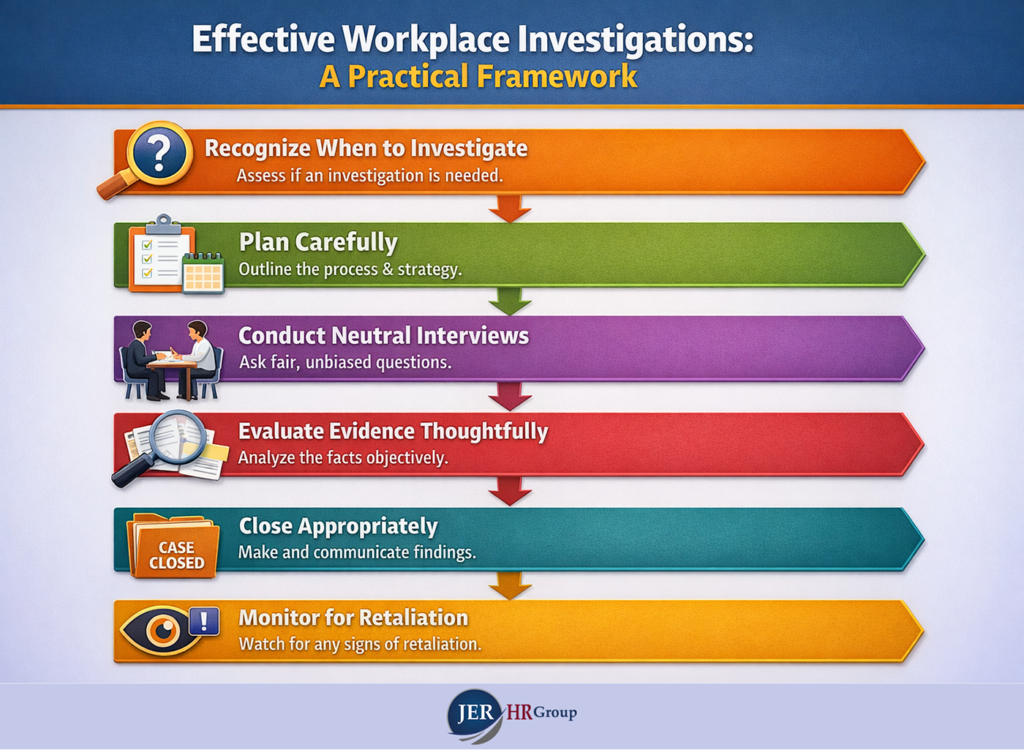
When HR professionals and leaders are equipped with a practical, step-by-step framework, recognizing when to investigate, planning carefully, conducting neutral interviews, evaluating evidence thoughtfully, closing appropriately, and monitoring for retaliation, they move from uncertainty to assurance. And in today’s workplace, that confidence makes all the difference. In a workplace landscape defined by heightened scrutiny and evolving expectations, that authority is not simply beneficial; it is essential.
What happens next matters.
JER HR Group’s team of highly qualified HR professionals can help you skillfully conduct workplace investigations to conclusion.